The EPIICAL Consortium developed an experimental immunological platform to inform research on viral eradication.
Flow cytometry
What
State of the art multi-parameter flow cytometry has been implemented throughout the EPIICAL laboratories.
Why
To assess the immunological profile associated to size and characteristics of HIV reservoir in children perinatally infected with HIV.
Results
The EPIICAL consortium identified immune check inhibitors and markers of immune activation able to distinguish between individuals with low or high viral reservoir.
A T cell immune signature associated with size of viral reservoir in a pediatric population. Frequencies of PD-1+ and TIGIT+ CD4 T cells along with the frequency of HIV-specific CD4 T cells were at the core of this immune signature and able to discriminate between individuals with low or high viral reservoir. This signature could be used to focus interventions toward relevant targets or as an endpoint for testing the efficacy of therapies aimed to achieve HIV remission in pediatric populations.
Correlation analysis of Predictors for HIV-1 DNA reservoir size
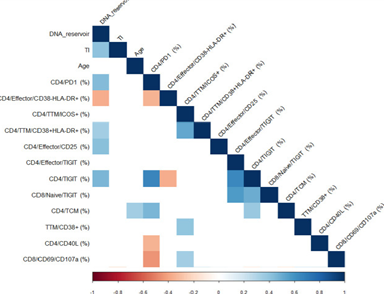
From Rinaldi S. et al PLoS Pathog 2021 T cell immune discriminants of HIV reservoir size in a pediatric cohort of perinatally infected individuals – PubMed (nih.gov)
B cell phenotype analysis showed a persistence in immune senescence and immune activation despite long term viral suppression in people living with HIV. (Ruggiero A, Front. Immunol 2022)
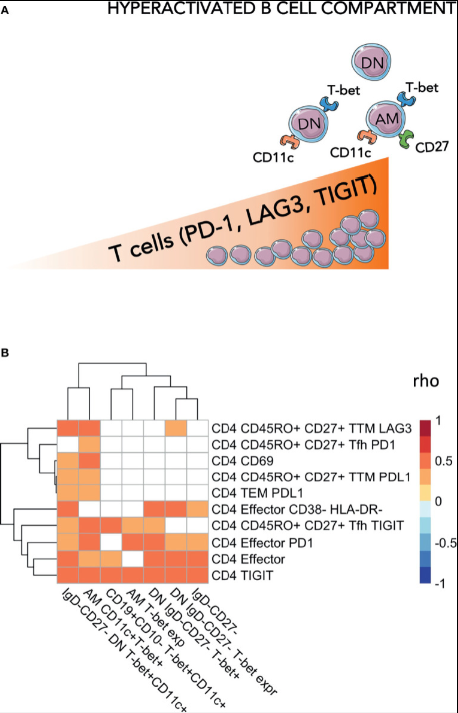
Levels of exhausted T-cells are positively associated with hyperactivated B-cells. In (A) a cartoon showing the main findings of the figures are pictured. In (B) Heatmap plot showing Spearman correlations between exhausted T-cells and hyperactivated B-cells.
From Ruggiero A et al. Front Immunol 2022 Determinants of B-Cell Compartment Hyperactivation in European Adolescents Living With Perinatally Acquired HIV-1 After Over 10 Years of Suppressive Therapy – PubMed (nih.gov)
The presence of these Age associated B cells (ABCs) were strongly affected by time of ART start and associated with clinical, viral, cellular and plasma soluble markers of CARMA participants. Moreover, the expansion of ABCs also had a direct correlation on the capacity to develop Ab response following routine vaccination (e.g. Measles) and thus a dysfunctionality on memory B cell subset in people leaving with HIV (see figure below from Ruggiero A Front Imm 2022)
Plasma proteomic profiling
What
Proximity Extension Assay (PEA) technology allows the simultaneous investigation of 92 proteins in just one microliter per sample and the processing of 88 samples simultaneously (Olink ®). One of the EPIICAL laboratories is officially Olink Lab certified.
Why
The EPIICAL investigators aimed at defining proteomic profiles associated to immune response and inflammation in people living with HIV in order to select candidates for New Disease Modifying Treatment strategies (NDMTs).
Results
Recently the Consortium showed that the level of selected proteins were able to segregate patients with distinct SARS-CoV2 responses upon vaccination. These distinct profiles identified in the HC and HIV groups inform future investigations regarding mRNA vaccines in vulnerable populations.
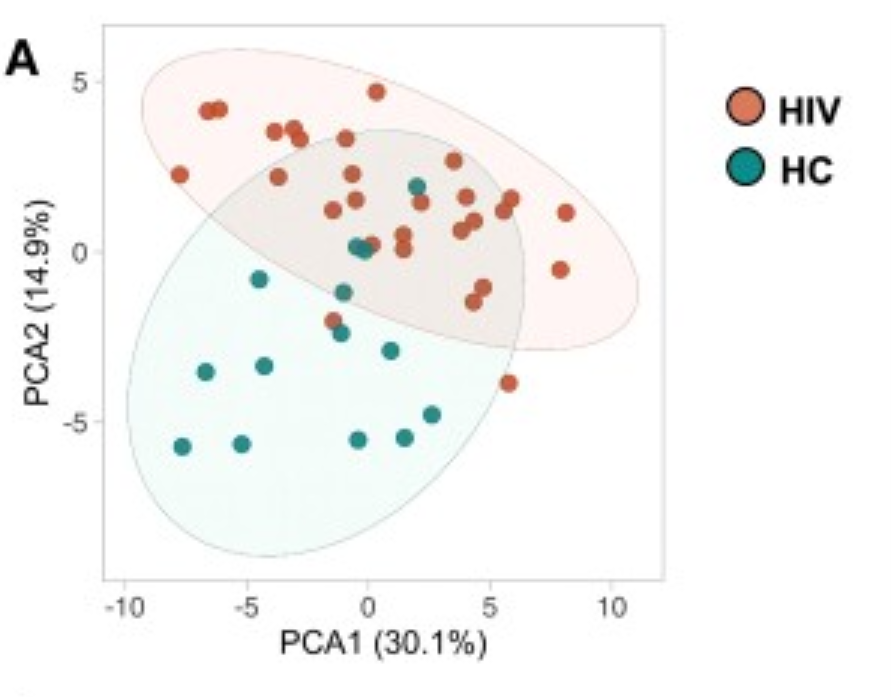
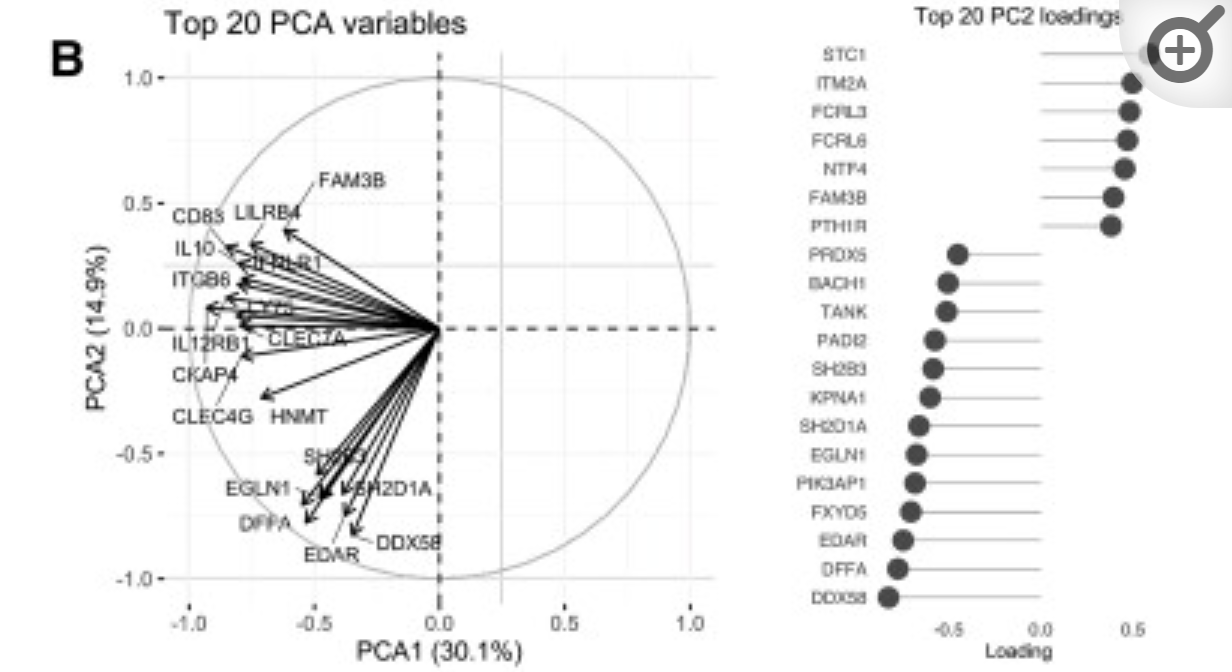
Human immunodeficiency virus (HIV)–infected patients demonstrate distinct correlation of baseline plasma proteomic profiles with BTN162b2 vaccine immunogenicity.
Transcriptomic profiles
What
Whole RNA Sequencing, performed by Oxford Nanopore technology, was applied to identify B and T cell subsets specific transcriptional signatures associated with early ART start and immune function and viral reservoir.
Why
Transcriptional profiling of total PBMCs and purified lymphocites’subsets may identify good candidates for NDMTs.
Results
HIV-specific memory B and T cells persist in children living with HIV who are treated early regardless of their serological status. Seronegatives and seropositives are distinguished by gp140-specific T cell function and by distinct transcriptional signatures of gp140-specific B cells after in vitro stimulation, presumably due to a different antigen exposure. Such qualitative insights may inform future immunotherapeutic interventions.
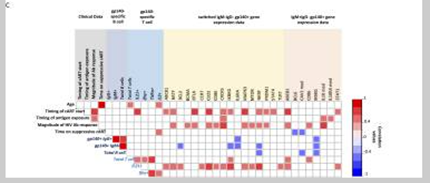
Gene expression analysis in gp 140-specific B cell subsets
From Cotugno N et al. AIDS 2020 Early ART-treated perinatally HIV-infected seronegative children demonstrate distinct long-term persistence of HIV-specific T and B cell memorys (nih.gov)
Single cell RNASeq assay for mapping transcriptional profiles of selected immune subset
What
Single-cell RNA-seq (scRNA-seq) represents an approach to identify biologically relevant differences between cells at single cell level. Gene expression in individual cells can be measured for thousands of cells in a single experiment.
Why
By analyzing the transcriptome of a single cell, the heterogeneity of a cell population is captured and resolved to the fundamental unit of all living organisms—the cell.
Results
This analysis allowed us to deeply profile gene induction in T cells in response to Gag stimulation and interrogate the effect of manipulation of immune checkpoint signaling in T cells.
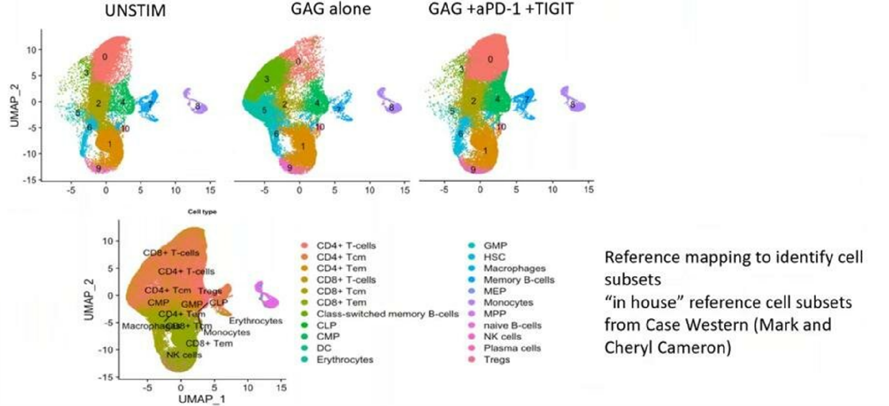
Single cell RNA Seq on purified T cells from Miami adolescent cohort. UMAP clustering shows the effect of blocking antibodies against PD1 and TIGIT on gag-stimulated T cells. CD4 and CD8 T cell subsets are identified using in house reference mapping.
Artificial Intelligence Applied to in vitro Gene Expression Testing (IVIGET)
What
Probes labelled with fluorochromes are optimized to sort-purify antigen-specific B and T cell subpopulations, analyzed for gene expression after in-vitro stimulation.
Why
This technique is used to define the gene expression dynamics associated with HIV specific immune response upon HIV vaccination, as well as upon other NDMTs.
Results
These data show how a predictive bioinformatic model applied to transcriptional analysis deriving from in-vitro stimulated lymphocytes subsets may predict poor or protective vaccination immune response in vulnerable populations, such as people living with HIV. The same approach may be used to predict the efficacy of any vaccine or NDMTs interventions.
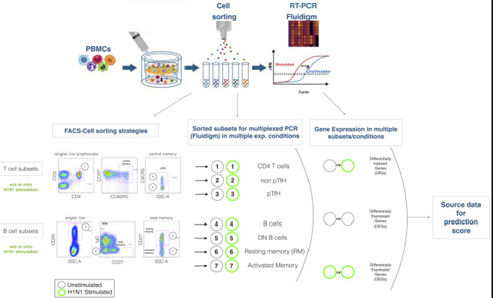
The cartoon on the top panel depicts the experimental procedure. Briefly, total PBMCs are in 2 aliquotes, one stimulated and the latter unstimulated. After sorting lymphocite subsets, gene expression is analyzed by Fluidigm Biomark. Bottom panel describes the gating strategies and the lymphocites subsets selected for sorting and gene expression analysis. Mathematical analysis applied on the subsets in order to obtain differentially expressed genes (DEGs) and differentially induced genes (DIGs) are described.
From Cotugno et al. Front Immunol 2020 Artificial Intelligence Applied to in vitro Gene Expression Testing (IVIGET) to Predict Trivalent Inactivated Influenza Vaccine Immunogenicity in HIV Infected Children – PMC (nih.gov)
Telomere length analysis and receptor sequency
What
qPCR was used to quantify HIV-1 DNA copies on CD4 cells, relative telomere length (marker of cellular senescence) and levels of T-cell receptor rearrangement excision circle (TREC, marker of thymic output) on CD4 and CD8 cells.
Why
Persistence of HIV-1, causing chronic immune activation, is a key determinant of premature senescence. Early antiretroviral therapy (ART) has been associated with a reduced HIV-1 reservoir in children with perinatally acquired HIV-1 (PHIV), but its impact on the senescence process is an open question.
Results The Consortium demonstrated the association between telomere shortening and HIV-1 reservoir. Timing of ART initiation in infancy has long-term consequences on the immune and biological ageing profile. Read more.
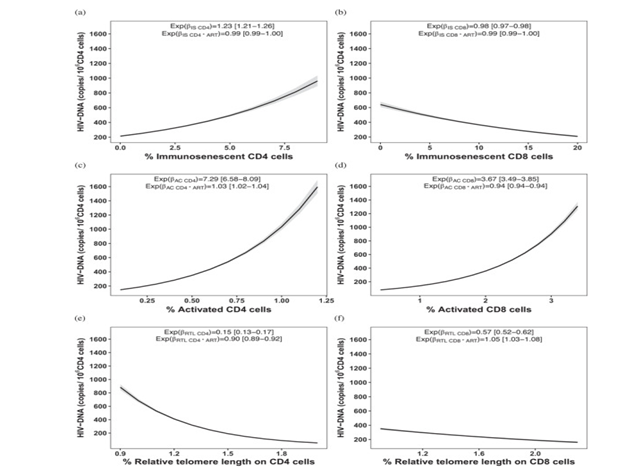
Associations with HIV‐1 DNA levels. Associations between HIV‐1 DNA levels in senescent CD4 cells (a), senescent CD8 cells (b), activated CD4 cells (c), activated CD8 cells (d), relative telomere length of CD4 cells (e) and relative telomere length of CD8 cells (f). Incidence rate ratio coefficients (Expβ) and their interaction with age at ART start (Expβ*age at ART start) were calculated using the multivariable Poisson regression model. The Expβ of each subset represents the association between this subset and the HIV‐1 reservoir adjusted by the age at ART initiation. The Expβ*age at ART start states the effect of this subset on HIV reservoir for every month elapsed without ART initiation. Predictors with a positive association with HIV‐1 DNA have an Expβ coefficient above 1; those with an inverse association have an Expβ coefficient below 1
From Dalzini et al. J Int AIDS Soc 2021 Size of HIV‐1 reservoir is associated with telomere shortening and immunosenescence in early‐treated European children with perinatally acquired HIV‐1 – PMC (nih.gov)