High-throughput analysis using artificial intelligence and advanced statistical methodology
What
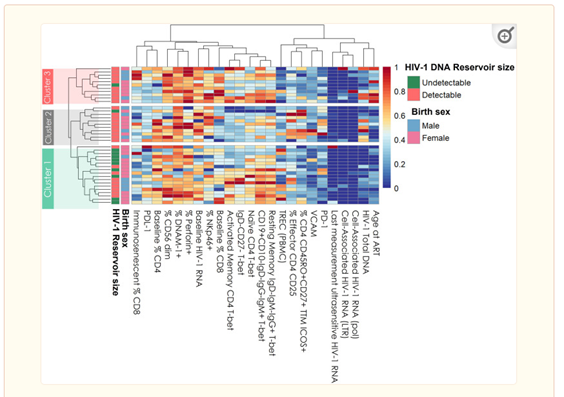
Hierarchical clustering was performed using Pearson correlation as the distance metric and WARD.D2 as the clustering method. The most informative variables were selected using an unsupervised lasso-type penalty selection for sparse clustering.
Why
Our Consortium studies provide high-dimensional information from small sample sizes. The benefits and challenges of accumulating large amounts of biological information and modeling complex variable interactions are more tangible than ever. Integrating multi-level information could reduce the prediction model’s complexity and provide a unique opportunity to identify clinically relevant HIV-1 subphenotypes. Distinct phenotypes may respond differently to different therapies in proof-of-concept trials. In the future, we may be able to design directed, individualized therapeutic approaches for HIV-1 infected children pursuing a path to a cure.
Results
Three HIV pediatric subphenotypes with different virological and immunological features were identified. The most favorable cluster was characterized by a higher rate of immune reconstitution and a slower disease progression, and the less favorable with more senescence and high reservoir size. In the near future therapeutic interventions for a path of a cure might be guided or supported by the different subphenotypes. In the figure, the cluster 1 showed clinical, immunological and virological features in general favorable; the cluster 3 showed values in general less favorable, and cluster 2 showed intermediate feauters.
Mathematical Modelling
HIV dynamics in perinatally-infected infants on antiretroviral therapy
What
Description of HIV dynamics in an infant on ART using a deterministic ordinary differential equation (ODE) model.
Why
Understanding the dynamics of HIV suppression and rebound in this age group is crucial to optimizing treatment strategies and increasing the likelihood of infants achieving and sustaining viral suppression.
Results
A deterministic model of HIV infection in adults cannot explain the full diversity in infant trajectories. The Consortium adapted this model to include imperfect ART adherence and natural CD4 T cell decline and reconstitution processes in infants. Individual variation in both processes must be included to obtain the best fits. Infants with faster rates of CD4 reconstitution on ART were more likely to experience resurgences in VL.
Overall, EPIICAL’s findings highlight the importance of combining mathematical modeling with clinical data to disentangle the role of natural immune processes and viral dynamics during HIV infection.