The EPIICAL Consortium developed an experimental virological platform to inform research on viral eradication.
HIV DNA
What
Cell-associated HIV-1 DNA is quantified in PBMCs infected with HIV-1.
Why
HIV DNA is an important viral marker and its monitoring plays a critical role in the fight against HIV.
Results
The EPIICAL Consortium demonstrates that HIV DNA measurement of the same samples can vary significantly from one laboratory to another and shows that when carefully selected, reference materials can reduce measurement variability and harmonize HIV DNA quantification across laboratories, which will help contribute to improved diagnosis and clinical management of patients living with HIV.
From Le Duff et al. Microbiol Spectr 2022 Assessing the Variability of Cell-Associated HIV DNA Quantification through a Multicenter Collaborative Study – PubMed (nih.gov)
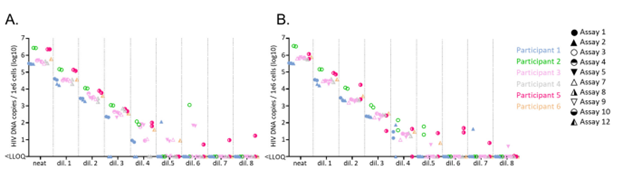
Quantification of CA HIV DNA in the panel of 8E5 cells. Quantifiable measurements of CA HIV DNA in the panel of 8E5 cells containing either 1e6 cells per vial (A) or 5e6 cells per vial (B) and in the panel of A3.01 only (negative control)
Tat/rev Induced Limiting Dilution Assay, (TILDA)
What
Tat/rev Induced Limiting Dilution Assay, (TILDA) is an alternative method to quantify the HIV-1 reservoir. TILDA estimates the frequency of latently infected cells by probing the presence or inducibility of tat and rev multiply spliced HIV-1 RNA.
Why
TILDA allows to measure the frequency of cells with inducible multiply-spliced HIV RNA, as these transcripts are usually absent in latently infected cells but induced upon viral reactivation.
Results
The HIV latent reservoir in resting memory CD4+ T cells precludes cure. Characterization of latency reversal kinetics and baseline immune activation in children has implications for latency reversal strategies toward reservoir clearance and remission.
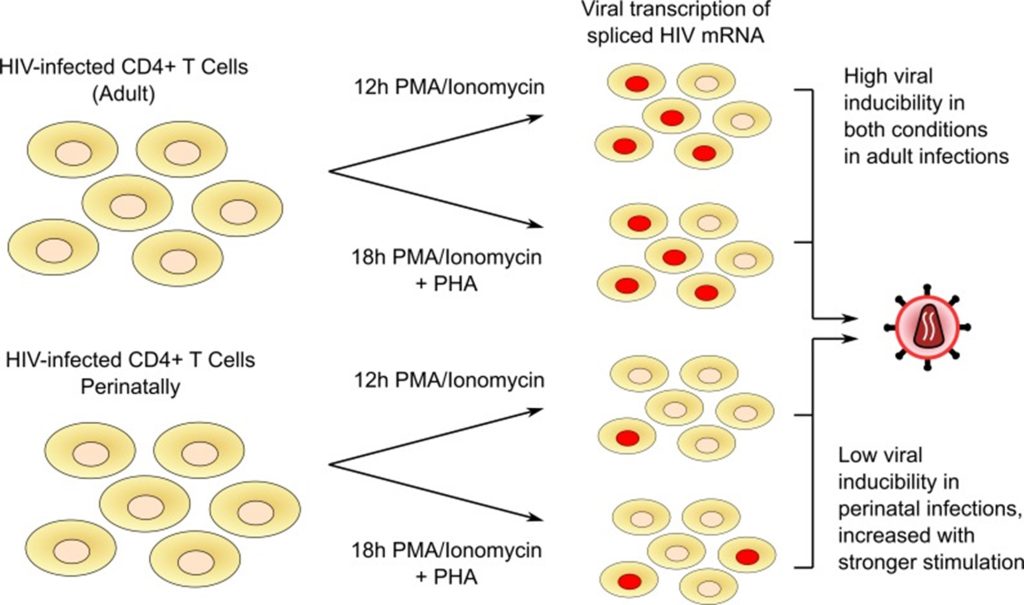
From Dhummakupt A. et al. JCI 2020 Differences in inducibility of the latent HIV reservoir in perinatal and adult infection – PubMed (nih.gov)
HIV-1 antibody response as a footprint of the viral reservoir in children vertically infected with HIV
What
Detection of HIV-1 specific antibodies to distinct viral antigens to inform viral reservoir
Why
A simple, inexpensive and reproducible assay from little sample volume (less than 100uL) inform on viral persistence and HIV reservoir. This tool may be useful for screening children, in resource-limited settings.
Results
EPIICAL studies have demonstrated that the detection and measurement of HIV-1 specific antibodies provide an effective estimate of PBMC HIV-1 DNA levels in children with durable suppression of HIV-1 replication after early ART initiation.
Association between timing of ART initiation, HIV-1 specific antibody responses, and HIV-1 persistence in virally suppressed perinatally HIV-infected children.
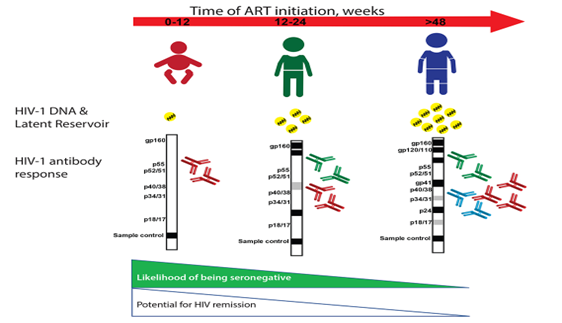
From Palma P. et al. Lancet HIV 2020 The HIV-1 antibody response: a footprint of the viral reservoir in children vertically infected with HIV – PubMed (nih.gov)
HIV Full Length Individual Proviral Sequencing (FLIP-Seq)
What
The FLIP-Seq is a high-throughput method designed to amplify and sequence single, near full-length (intact and defective), HIV-1 proviruses. FLIPS allows determination of the genetic composition of integrated HIV-1 within a cell population.
Why
HIV-1-infected cells that persist despite antiretroviral therapy (ART) are frequently considered “transcriptionally silent”. Sequencing the integrated HIV provirus to define its replication competence.
Results
The Consortium has developed and optimized the near-full-length individual proviral next generation sequencing (FLIP-seq), an approach that allows to distinguish intact from defective proviruses, infer clonality based on proviral sequence identity, and evaluate sequence variations consistent with mutational escape from antiviral immune responses . According to these results EPIICAL has virological information that can help with the selection of good candidates for NDMTs in people living with HIV.
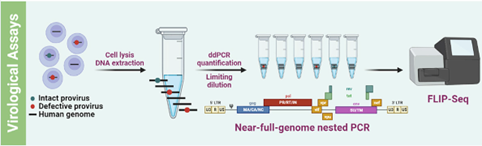
Figure from Cell Reports 2022
Matched integration site and proviral sequencing (MIP-Seq)
What
MIP-Seq is an experimental approach involving multiple displacement amplification of individual proviral species, followed by near-full-length HIV-1 next-generation sequencing and corresponding chromosomal integration site analysis.
Why
MIP-Seq allows the sequence of individual proviruses to be linked to the integration site in the genome.
Results
Chromosomal integration of genome-intact HIV-1 sequences into the host genome creates a reservoir of virally infected cells that persists throughout life. The EPIICAL consortium use matched integration site and proviral sequencing (MIP-Seq), followed by near-full-length HIV-1 next-generation sequencing and corresponding chromosomal integration site analysis to selectively map the chromosomal positions of intact and defective proviruses in HIV-1-infected children undergoing long-term antiretroviral therapy.
PRIP-seq
What
PRIP-seq is a multidimensional assay for HIV-1 reservoir cell profiling.
Why
This assay simultaneously captures the proviral sequence, the corresponding chromosomal integration site, and the expression of HIV-1 RNA in single virally infected cells.
Results
The EPIICAL consortium has developed and optimized PRIP-seq which allows for the global mapping of transcriptionally active and silent proviruses in paediatric patients receiving suppressive antiretroviral therapy.
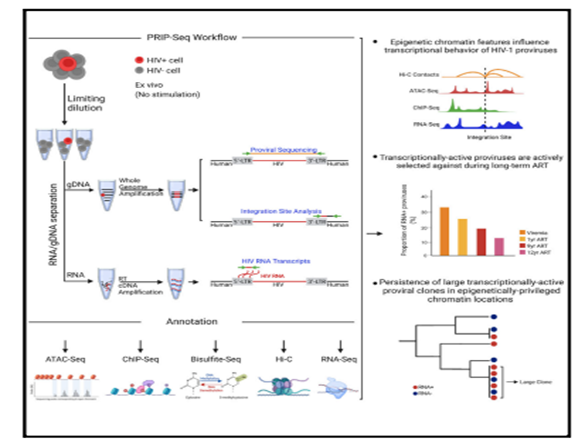
Einkauf KB Cell 2021 Parallel analysis of transcription, integration, and sequence of single HIV-1 proviruses (cell.com)